

Essential Ecological Survey Calendar for Land Purchasers & Developers - Free Download
The presence of a protected species on your site can significantly impact the progress of your land development project, making it essential to plan your surveys using an ecology survey calendar to ensure accurate timing and compliance with environmental regulations.
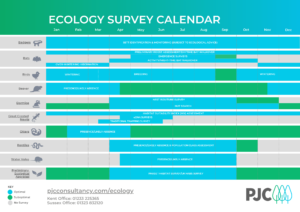
Our free ecology survey calendar, incorporating a wildlife calendar, outlines the method we use and the optimum time(s) of the year to carry out an ecological surveys by species.
Many species are protected by law. Therefore, it is essential to carry out ecological surveys prior to purchase, submission of a planning application or master planning to determine whether any of these protected species live on your land. If they do, your Local Authority will insist on mitigation to prevent loss of protected wildlife populations and habitats before planning permission is granted.
When are the best wildlife and reptile survey times?
Different species are active at different times of the year, and surveys are therefore also restricted to such seasonal timings. Our Free ecological survey calendar will tell you this by clearly indicating, for each species, the optimum survey periods, sub-optimal survey periods and the times when surveys are not possible.
Here’s a run down by species which you can download in our ecology survey calendar;
Badgers Surveys
Badgers and their setts are strictly protected, requiring surveys before any land disturbance.
Optimal survey time: Year-round
Survey methods: Sett identification and monitoring
Bat Surveys
Bats and their roosts are protected by law, requiring careful planning for any development.
Preliminary Roost Assessments: Year-round
Emergence surveys: May–August
Activity/Night-time Bat Walkover: April–October
Winter hibernation surveys: December–February
Bird Surveys
Bird surveys depend on the species and their seasonal behaviours.
Breeding bird surveys: Mid March–August
Wintering bird surveys: October-Mid March
Beaver Surveys
Beavers modify landscapes by creating dams and lodges, which support wetland biodiversity.
Optimal survey time: Mid-Nov to Mid April
Survey methods: Presence/absence surveys
Dormice Surveys
Dormice are elusive and require specialised survey techniques.
Nut searches (for feeding signs): April-November
Nest box/tube surveys: April–September
Great Crested Newt Surveys
This protected amphibian requires specific survey methods at different times of the year.
Habitat Suitability Index (HSI) assessments: Year-round
eDNA surveys: Mid April–June
Population assessments (trapping): Mid March–Mid June
Otter Surveys
Otters are found along waterways, and surveys focus on their habitat use and activity signs.
Optimal survey time: February-April
Survey methods: Presence/absence surveys
Reptile Surveys
Reptiles such as grass snakes, slow worms, and common lizards require warm conditions for activity.
Optimal survey time: April–September
Survey methods: Presence/absence surveys, population class assessment
Water Vole Surveys
Water voles are one of the UK’s most threatened mammals, requiring careful survey planning.
Optimal survey time: Mid April–September
Survey methods: Presence/absence surveys
Preliminary Ecological Appraisal (PEA)
A broad habitat assessment that helps determine the need for further species-specific surveys.
Optimal survey time: April-September
Survey methods: Phase 1 Habitat Surveys, UKHAB Surveys
PJC Consultancy holds licences to survey all the major UK protected species groups. We can advise you on how their presence can affect your site and guide you through the process of surveying, reporting and taking the necessary measures to continue with your project, including how to provide opportunities for habitat creation and enhancement.
To find out more about our environmental or our ecology services, please browse:



If you have a project you'd like to discuss, please call us on 01233 225365 / or send us a message.
