

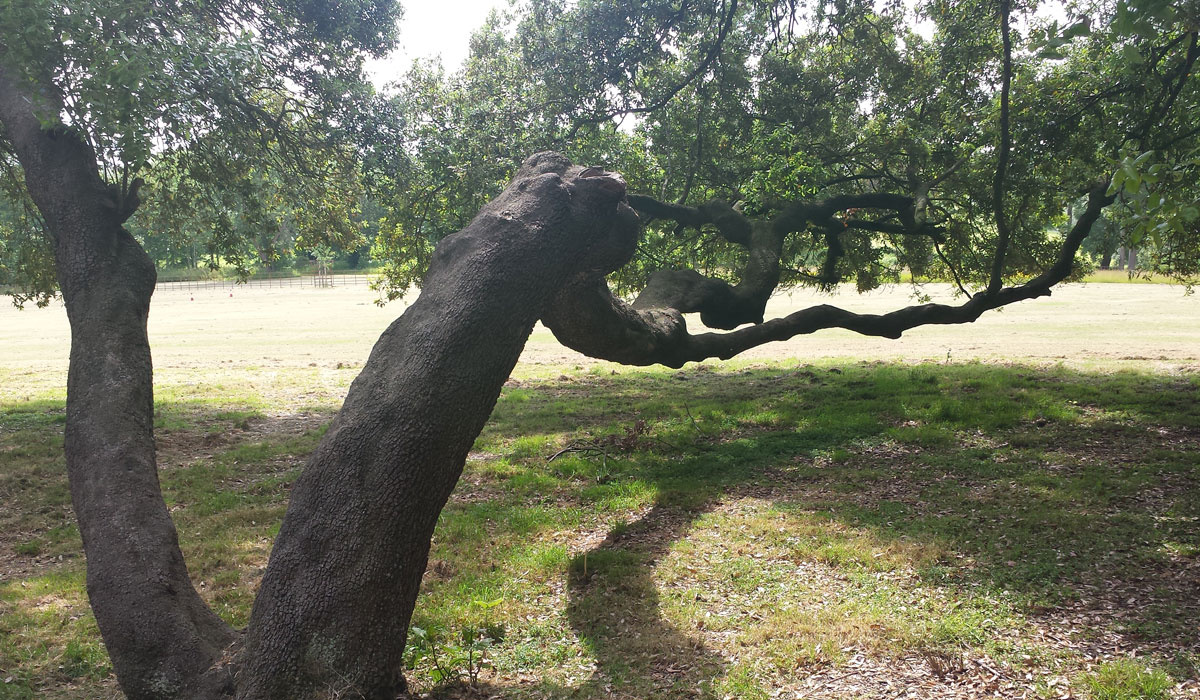
A tree is a self-optimising mechanical structure (Mattheck & Bremoer 1994). So what does this actually mean, how do we assess whether a tree is at risk of failure and how can a hazard evaluation survey help you.
A tree reacts to mechanical and physiological stresses by investing in vigorous growth to re-enforce weak areas whilst reducing growth in areas suffering less stress. The simplest example of this can be seen on the wind swept trees dotted throughout the peaks of the South Downs. The canopies of these trees are constantly being battered by strong prevailing winds. In response, tree crowns are essentially manipulated by the wind and forced to grow in an almost aerodynamic fashion. To compensate for their unevenly balanced crown scaffold, the tree’s root network will develop considerably more on the opposite side to counter the un-even weight distribution. In addition, the trees stem will gain incremental growth on the side of the lean to further reduce the likelihood of failure as a result of excessive mechanical stresses.
Dr Claus Mattheck, a theoretical physicist and expert in failure analysis, introduced a biomechanically based assessment system known as Visual Tree Assessment (VTA). Our fully qualified and experienced arboricultural consultants utilise VTA methodology to make educated decisions on a trees structural and physiological condition by identifying symptoms, resulting from weak areas or areas suffering excessive mechanical stress.
A leaning tree may look as though it is a high risk of failure, however this is very rarely the case and they should not be axed based on this characteristic alone. It is vital that trees are managed and maintained correctly to allow a continued amenity and landscape contribution for future generations to enjoy. In order to safeguard the future of your tree stock but also fulfill your duty of care as a land owner, our arboricultural consultants can carry out a hazard evaluation survey and highlight trees requiring remedial works utilsing up to date survey methodology. We specialise in carrying out small scale and large-scale hazard evaluation assessments for domestic and commercial clients, local authorities and infrastructure management companies.
Contact us today to speak with one of our arboricultural consultants and discuss your hazard evaluation survey requirements.