

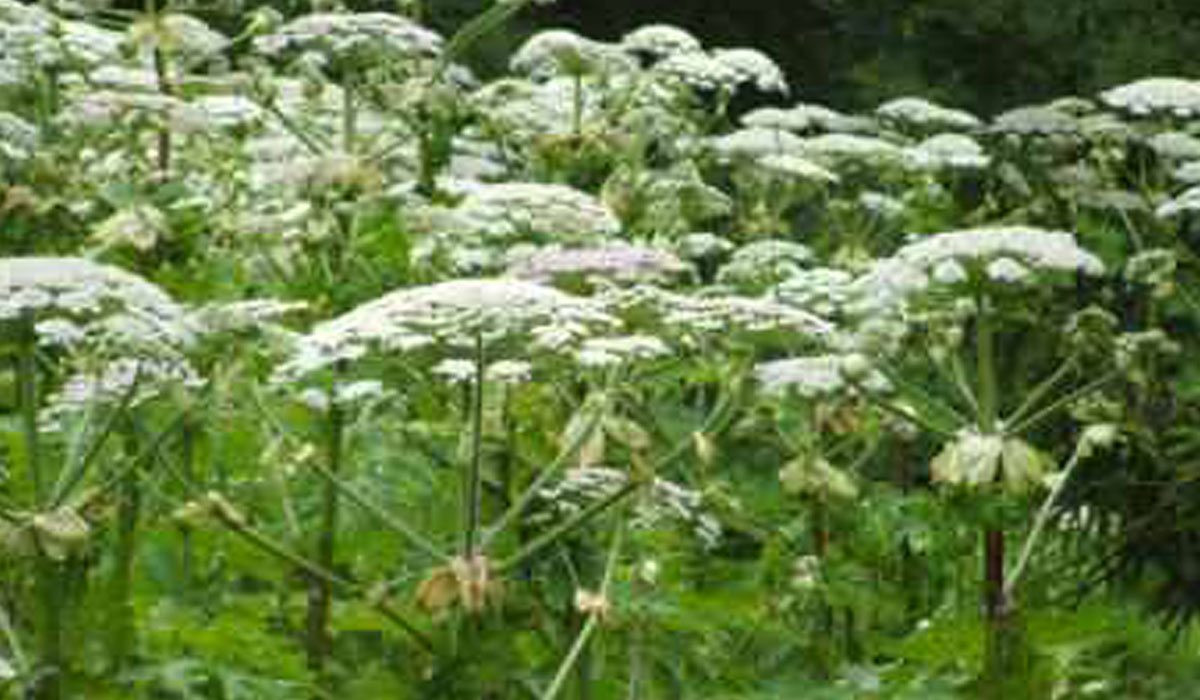
The long nights and school holidays mean that across the country, parks and green spaces are bursting at the seams, as people young and old take to the great outdoors. The peace has somewhat been broken in recent weeks however, as stories of a “monstrous” poisonous plant have made headlines, reporting that several people have been hospitalized after coming into contact with it. So what is this green-leaved monster, and what can we do to avoid such encounters?
Giant Hogweed (Heracleum mantegazzianum). As its name suggests it really is a giant, growing up-to 5m in height, with leaves reaching 25cm in diameter. Often confused for its smaller relative, Milk Parsley, these dinner-plate sized white flowers provide the perfect playground for unknowing small adventurers. Unlike its comparison, Giant Hogweed has thick purple stems, often mottled in pattern, signs that help distinguish between the two. Its sap contains high levels of furanocoumarins, chemicals that when come into contact with human skin, cause increased sensitivity to sunlight. This heightened “photo-sensitivity” can cause tremendous burns and blisters that left untreated, can be fatal. So where has this giant sprung from? Giant Hogweed is no stranger to the UK, after having been introduced to botanic gardens in the 19th century. It quickly escaped however, and became well established up and down the country. As a non-native and highly invasive species, it has since been colonising entire areas, threatening more than just our own health. Its substantial structure means it quickly blocks out light to those smaller plants, dwarfed by its presence, impacting upon a host on insects who depend on those plants suffocated. Its surprisingly strong root network causes problems below the surface too, as its enormous water requirements drain surrounding ground, sometimes resulting in subsidence, causing damage to nearby buildings. Soil erosion caused by its winter die-back can also cause similar problems.
So what does this all mean, and what should you do if you think you have giant hogweed on your property? Schedule 9 of the Wildlife & Countryside Act 1981 means that it is an offence to grow Giant Hogweed, and some authorities have the right to demand its removal. If you think you may have Giant Hogweed growing on your site, then the advice is to contact an ecological advisor immediately. Consultancies offer a wide range of services that cannot only help to remove the plant, but ensure that the likelihood of its regrowth is minimised. Self-removal is recommended against, not only because of the danger it can present, but because of the risk of spreading, rather than ridding the plant. Its seeds can be easily dispersed during removal, and unless controlled, will help encourage its spread. Similarly, unless its roots are removed efficiently, left-overs can linger in the ground before re-sprouting as another growth.
In the highly connected world we live in, alien invaders such as Giant Hogweed are becoming increasingly common to our shores. However, careful, professional control, can help eradicate the threat, protecting, you, your property and the wider ecosystem.
If you need advice on the control, removal and identification of invasive species, such as Japanese Knotweed, Giant Hogweed or Rhododendron, then please feel free to contact us, and our team of experts will be happy to help.