

Amphibians Assemble -
How can we help amphibians in the UK
20th March 2023 - Posted in: Ecological, General
How can we help amphibians in the UK
Who are they?
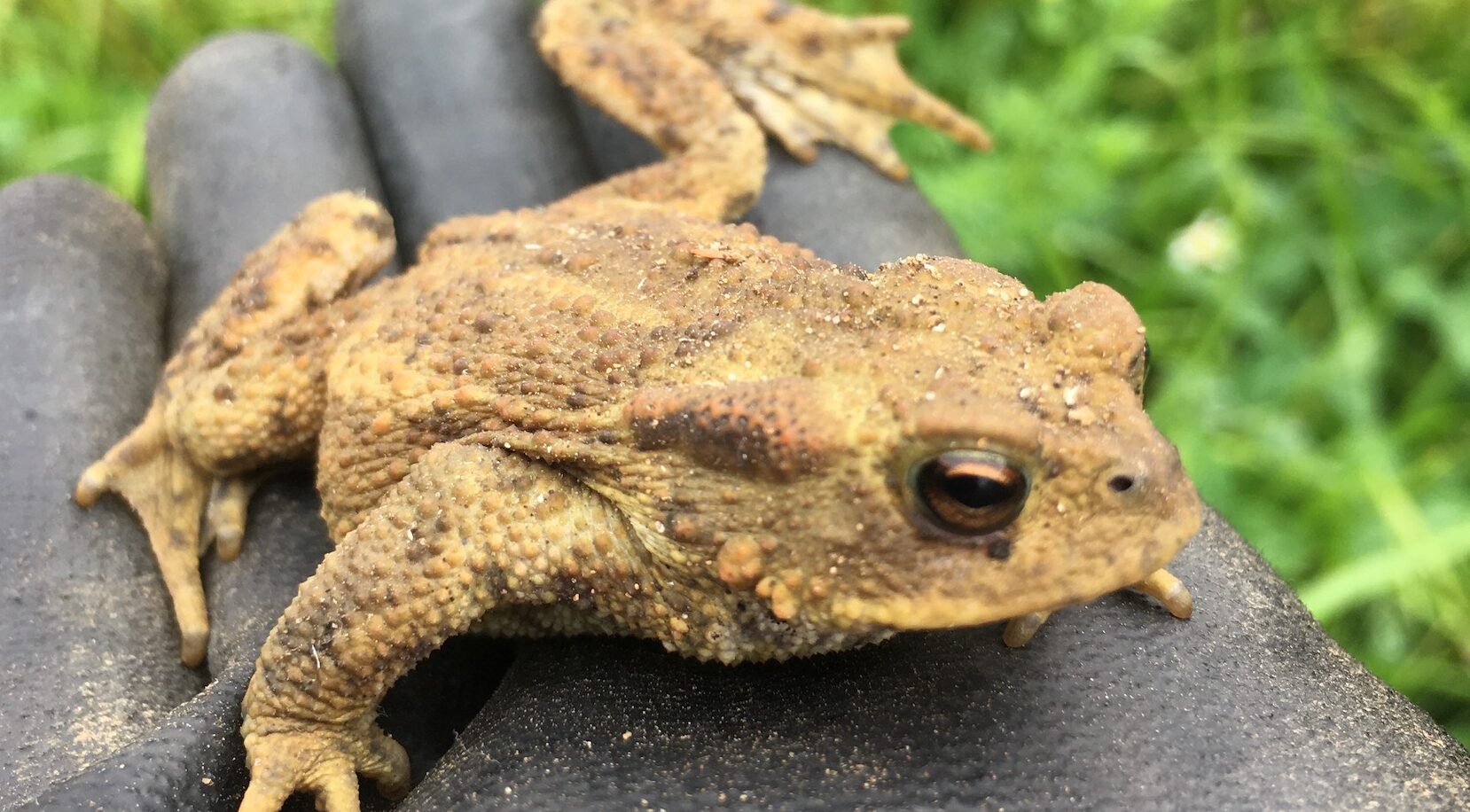
Amphibians are cold-blooded vertebrates that carry out an egg-larva-adult life cycle. Here in the UK, we have seven native species: common frog Rana temporaria, common toad Bufo bufo, smooth newt Lissotriton vulgaris, palmate newt Lissotriton helveticus, great crested newt (GCN) Triturus cristatus, natterjack toad Epidalea calamita, and pool frog Pelophylax lessonae. 50 years ago, species such as these were frequent visitors to our gardens, now unfortunately, we are more likely to see amphibian roadkill.
With increasing threats from climate change, pollution, habitat conversion and infrastructure expansion, amphibian populations have been declining since the 1970’s. Habitat conversion is one of the major contributors to population decline; data recorded by Natural England shows around 50% of UK ponds have been destroyed over the last century. The UK’s largest native newt, GCN, has had a population decline so severe that it is protected under British AND European law which makes it an offence to; kill, injure, capture or disturb them; damage or destroy their habitat; and to possess, sell or trade GCN. This law refers to all life stages including eggs. In addition, the British protected species, common toad, has experienced a population decrease of 68% across the UK, with some areas, including the South East, seeing more severe declines over the last 30 years.
Where are they going?
Most amphibian species develop as larvae in waterbodies, then as they mature into their adult form, they vacate and spend the majority of their adult lives in terrestrial habitats. In spring, as night temperatures begin to rise above 5°C, amphibians begin their migration. Usually during or after heavy periods of rainfall, amphibians begin emerging from hibernation in search of breeding ponds. Using a combination of environmental cues such as; visual, olfactory, auditory, celestial and lunar, they navigate toward breeding ponds. Then, after the breeding season in the summer, amphibians move away from breeding ponds and gradually return to their previous foraging habitats. Finally, in winter, they migrate back to their hibernation sites.
Toads are very determined creatures and often return to ancestry ponds for the breeding season, travelling up to 5km to reach their destinations. Sadly, migration routes are often intersected and obstructed by large infrastructure, such as roads and during migration, hundreds of individuals are killed before being able to contribute to the overall success and longevity of their local population. It is estimated that 20 tonnes of toads are killed on roads every year throughout the UK alone. Unfortunately, with today’s rate of development, this looks set to rise.
How can we help them on their journey?
Due to the many obstacles amphibians face in today’s climate, it is vital that these vulnerable species are given a helping hand. Charities, amphibian groups, and consultancies, have teamed up with local councils throughout the UK to step up to the challenge. Toads on Roads (Froglife) projects encourage volunteers throughout the UK to help patrol toad crossings and safely transport them. In 2022, the patrols safely helped 92,734 toads at 187 crossing sites across the UK, as well as a variety of other amphibian species, that otherwise would have been in danger.
In addition, Charlcombe Lane in Bath, which is located on one of the country’s major amphibian migration routes, has adapted an annual temporary road closure of Charlcombe Lane to give amphibians the best possible chance of crossing to breeding ponds in Charlcombe Valley. The Charlcombe Toad Rescue Group, with support from the local Mayor and the Bath and North East Somerset Council, have saved over 30,000 amphibians over 20 years of road closures.
However, the future for a sustainable amphibian migration period may lie on the creation of wildlife passage systems such as amphibian tunnels built under major roads. These essentially allow amphibians, and other animals, to safely cross roads that lie on migration routes. This has proven successful in an amphibian conservation project in Yorkshire, where two aquatic habitats accompanied by established terrestrial habitat were connected via an under-road tunnel. Over a 4-year monitoring period over 1000 amphibians were recorded crossing safely through the tunnel, along with other species such as hedgehogs, voles, shrews, rats and mice. The tunnel was accompanied by mitigation fencing and it was noted that during this time no amphibian casualties were recorded within the site area. The only issue that may arise from these structures is potential pollution from cars leaking into the tunnels, so pressure washing will be required at the start of each year before migration begins.
Here at PJC, we provide practical site-specific assistance during the development process on a variety of sites, notably on a recent project two of our ecologists saved over 100 amphibians during habitat clearance works on a pond conversion project. Species included common toads, common frogs, palmate newts, and smooth newts, not to mention the translocation of hundreds of frog spawn.
Future for amphibians
In conclusion, there is light at the end of the tunnel, with continued progress from conservation projects, re-establishing habitat connectivity will hopefully result in population increase nation-wide for amphibians. Finally, with the introduction of Biodiversity Net Gain during infrastructure development, amphibian species may have a greater chance of survival as new habitats are created in upcoming developments.
If you feel as strongly as we do about amphibian conservation, why not ask your local planning authority to consider the incorporation of a trial road closure during the migration period or the addition of an amphibian tunnel across major roads in your area? And if you see a toad in the road, and it’s safe to do so, why not stop and lend them a helping hand to the other side.